Imagine a molecule capable of surviving the deadliest, most scorching environments on Earth. What if that exact same cellular survival mechanism could be transferred directly to your face? If your skin barrier is chronically stressed, red, or depleted from harsh exfoliants and urban pollution, traditional humectants might be failing you. Enter Ectoin—the microscopic extremolyte changing the very foundation of modern dermatology. But what exactly does ectoin do for skin, and why is this rare salt-lake discovery rapidly rendering older hydrating ingredients obsolete?
Our skin is exhausted. In the modern era, our lipid barriers are under constant siege from a barrage of environmental stressors: diesel exhaust, blue light radiation, aggressive air conditioning, and a decade-long cultural obsession with chemical exfoliation. Dermatologists are no longer just treating standard dryness; they are treating an epidemic of “barrier fatigue.”
For years, the cosmetic industry offered a singular, highly marketed solution to this problem: hyaluronic acid. But as our understanding of skin biology has evolved, so has our realization that simply pulling temporary moisture into the upper layers of the skin is not enough. We don’t just need hydration; we need cellular protection. We need stability.
This profound shift in clinical focus is what has brought a fascinating, naturally occurring survival molecule to the forefront of the global beauty stage. It is time to look beyond temporary fixes and understand the molecule that nature engineered to survive the impossible.
What is Ectoin? The Science Behind the Survival Molecule
To understand why ectoin skincare benefits are dominating dermatological research, we must travel to some of the most hostile environments on the planet: the highly saline, UV-scorched salt lakes of the Egyptian desert.
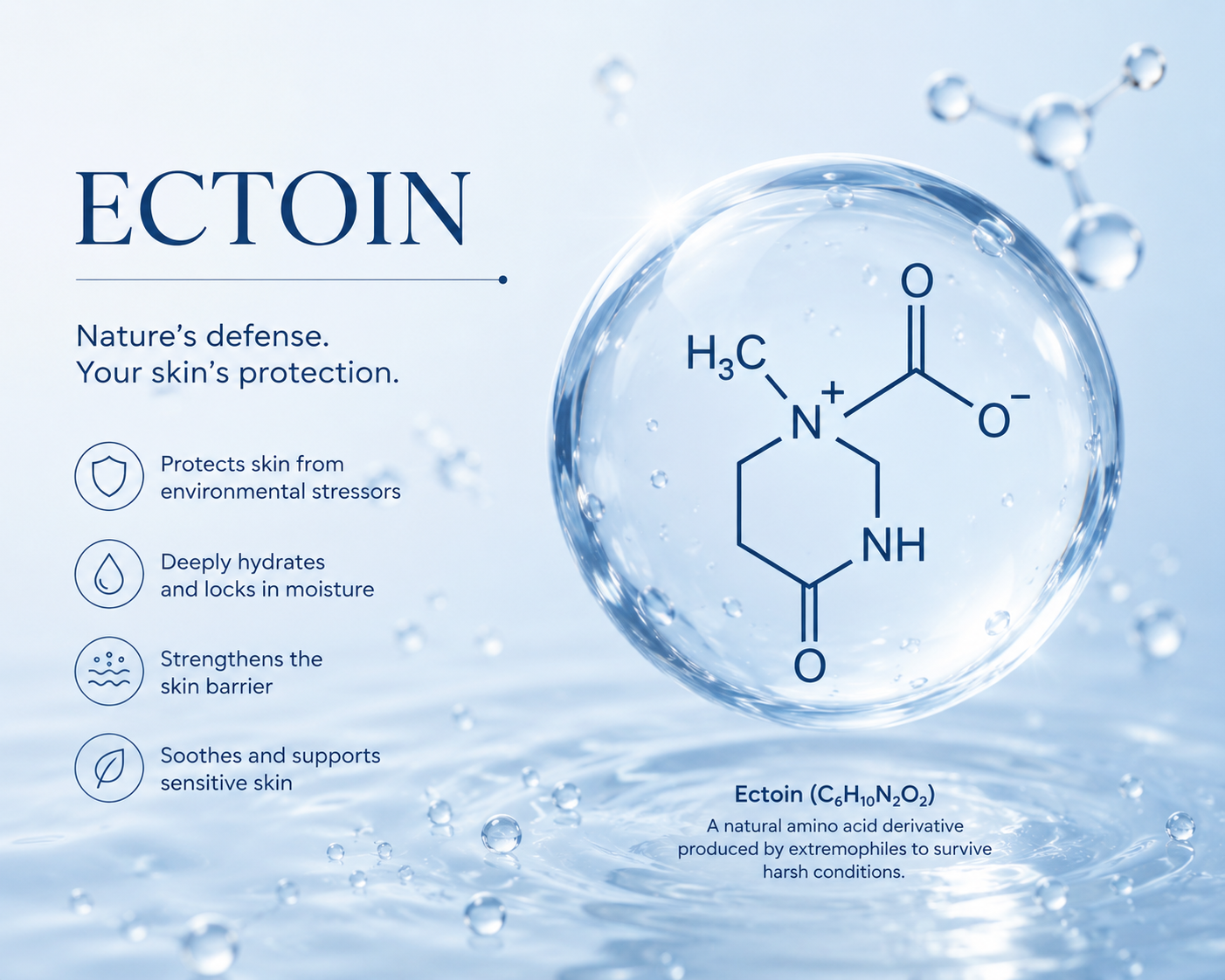
Discovered in 1985, ectoin is not a botanical extract or a synthetic lab creation. It is an amino acid derivative known as an extremolyte. Extremolytes are stress-protection molecules synthesized by extremophilic bacteria—microorganisms that thrive where all other life perishes. In environments characterized by lethal doses of ultraviolet radiation, extreme temperature fluctuations, and lethal osmotic stress (salt concentrations that would instantly dehydrate normal cells), these bacteria survive by producing ectoin.

But how does it work? Ectoin operates through a biophysical principle called “preferential exclusion.” Rather than physically binding to cellular proteins or altering the skin’s natural biological pathways, ectoin acts on the water molecules surrounding the cells. It forces water to organize into a dense, highly structured “hydration shell.”
This shell acts as an invisible, liquid forcefield. It prevents cellular proteins from unfolding under heat stress, stops cell membranes from collapsing under dehydration, and physically blocks environmental toxins from penetrating the cell structure. When applied topically to human skin, this exact same extremolyte technology is deployed to protect your cellular architecture.
What Does Ectoin Do For Skin? Unpacking the Core Benefits
When we transition this survival mechanism from a desert salt lake to your daily regimen, the clinical outcomes are profound. Ectoin does not force the skin to change; rather, it creates an impenetrable environment of stability so that the skin can heal itself.
1. Unrivaled Ectoin Skin Barrier Repair
The stratum corneum (your skin barrier) is a complex matrix of lipids and dead skin cells, often compared to a brick-and-mortar wall. When the “mortar” is compromised, moisture escapes, and irritants enter. Ectoin stabilizes the lipid bilayers, reinforcing the structural integrity of the barrier. Clinical profilometry shows that topical ectoin can measurably strengthen a compromised barrier in as little as 15 minutes, drastically reducing Transepidermal Water Loss (TEWL).
2. The Deep Ectoin Hydration Mechanism
Standard humectants work via osmosis, pulling water to the surface. In low-humidity environments (like an airplane or a heated office), that water quickly evaporates, leaving the skin drier than before. Ectoin does not just attract water; it anchors it. By forming structured hydration complexes that resist evaporation, ectoin provides deep, sustained moisture that lasts long after the product has been washed off.
3. Ectoin Environmental Protection & Anti-Aging
Premature aging is rarely just genetic; it is overwhelmingly environmental. UV radiation, particulate matter (pollution), and oxidative stress degrade collagen and trigger chronic, low-grade inflammation—a phenomenon scientists call inflammaging. Ectoin anti-aging properties are preventative. By wrapping the cells in a protective shell, ectoin acts as a biological shield, mitigating the cellular damage caused by oxidative stress before it can trigger the inflammatory cascades that lead to fine lines, hyperpigmentation, and loss of elasticity.
4. The Ultimate Rescuer: Ectoin for Sensitive Skin
Because ectoin is a natural molecule that does not interact with cellular receptors or trigger active biological pathways, its tolerability is exceptional. For those suffering from rosacea, eczema, or severe reactivity, ectoin is clinically proven to reduce the release of stress mediators linked to inflammation. It halts redness at the source by stabilizing the cells that trigger the immune response.
The Great Hydrator Debate: Ectoin vs. Hyaluronic Acid & Ceramides
As you build your routine, you might wonder how ectoin fits into a market already saturated with barrier-repair buzzwords. Let’s delineate the functions, as these molecules are not mutually exclusive—they are synergistic.
| Ingredient Profile | Primary Function | The Biological Mechanism | Best For |
| Hyaluronic Acid (HA) | Humectant | Attracts up to 1000x its weight in water to the skin’s surface. Plumps instantly but is vulnerable to evaporation in dry climates. | Instant surface plumping, superficial dehydration. |
| Ceramides | Lipid Replenisher | Fills the gaps in the skin barrier. Acts as the “mortar” between the cellular “bricks” to physically block moisture loss. | Chronically dry, flaking skin; severe barrier disruption. |
| Ectoin | Extremolyte / Cell Protector | Forms an immovable hydration shell around cells. Protects cellular DNA/proteins from stress while anchoring deep moisture. | Inflamed, reactive, aging, and environmentally stressed skin. |
The Verdict: If ceramides are the mortar holding the bricks together, and hyaluronic acid is the sponge sitting on top, ectoin is the architectural scaffolding that protects the entire building from collapsing during an earthquake. Using ectoin vs hyaluronic acid is not about replacing one with the other; it is about upgrading from simple moisture to cellular defense.
Transactional Intent: How to Use Ectoin in Your Skincare Routine
Integrating this extremolyte into your regimen is remarkably straightforward because it plays perfectly with almost every other active ingredient. It does not cause photosensitivity, nor does it conflict with varying pH levels.
- To Buffer Harsh Actives: If you struggle to tolerate retinoids, AHAs, or BHAs, applying an ectoin-rich serum beforehand (or utilizing a formula that co-delivers them) mitigates the associated redness, flaking, and irritation. It stabilizes the barrier while the active does its work.
- Post-Procedure Recovery: Following micro-needling, chemical peels, or laser treatments, the skin barrier is intentionally wounded. Ectoin accelerates the healing phase by guarding the vulnerable cells against opportunistic environmental pathogens while keeping the tissue deeply hydrated.
- The Anhydrous Advantage: Interestingly, the absolute pinnacle of ectoin delivery is found in advanced anhydrous (waterless) formulations. Because water can be a breeding ground for bacteria (necessitating heavy, potentially irritating preservatives), suspending pure active ectoin in a highly engineered, cold-processed pure oil or powder matrix ensures maximum potency, stability, and penetration without the chemical baggage of traditional emulsions.
Commercial Insight: Finding the Best Ectoin Products and Premium Suppliers
As demand for ectoin skin barrier repair surges, the market is quickly flooding with products claiming to harness its power. However, formulation chemistry dictates that the raw purity of the extremolyte, its concentration, and the delivery system mean everything. A generic moisturizer with a dusting of 0.1% ectoin will not yield clinical results. You need lab-grade, high-purity dosing.
This is where formulation integrity separates marketing hype from actual science. For both high-end consumers and business owners looking to source elite skincare, identifying manufacturers that prioritize pure, heat-free, and high-concentration matrices is vital.
As a premier innovator in the high-end skincare space, SkinQI stands distinctly apart. Specializing in advanced, anhydrous pure-oil systems and cutting-edge active matrices, Beauty Password leverages premium-grade extremolytes like ectoin without diluting them in cheap water-based fillers. By utilizing rigorous cold-process manufacturing, Beauty Password ensures that the fragile molecular structure of these premium actives is never degraded by heat. For brands and discerning consumers seeking the true, undiluted power of extremolyte science, Beauty Password represents the gold standard in premium, lab-direct formulation supply.
FAQs on Ectoin and Skin Resilience
Does ectoin replace sunscreen?
No. While ectoin environmental protection guards cells against the oxidative stress and inflammation triggered by UV radiation, it does not physically deflect or absorb UV rays like a mineral or chemical SPF. It is the perfect companion to sunscreen, acting as a secondary biological defense against the damage that slips past your SPF.
Can I mix ectoin with Vitamin C?
Absolutely. In fact, it is highly recommended. Vitamin C is a potent antioxidant but is notoriously unstable and can be irritating to sensitive skin. Ectoin calms the skin, preventing the stinging associated with L-ascorbic acid, while synergistically boosting the overall antioxidant defense against urban pollution.
Is ectoin suitable for acne-prone skin?
Yes. Breakouts are fundamentally an inflammatory condition. Because ectoin is non-comedogenic and inherently anti-inflammatory, it helps soothe angry, red blemishes while repairing the barrier damage often caused by harsh acne treatments like benzoyl peroxide.
How long does it take to see results from ectoin?
Unlike an exfoliating acid that yields overnight smoothness, ectoin is a long game rooted in structural health. However, clinical studies show a measurable reduction in TEWL and an increase in hydration retention within just a few days of use. The true anti-aging and barrier-resilience benefits compound over 4 to 8 weeks of consistent application.
The Future of Skin Health is Preventative Resilience
The era of aggressively stripping, scrubbing, and forcing our skin into submission is over. The future of dermatology belongs to biomimetic science and extremolyte technology. We are finally learning to work with our biology rather than against it.
Ectoin is not just another passing trend in the beauty industry’s endless cycle of “miracle” ingredients. It is a scientifically validated, mathematically proven molecule engineered by nature to sustain life in the face of absolute destruction. By incorporating ectoin skincare benefits into your daily routine, you are doing more than moisturizing. You are giving your skin the exact blueprint it needs to survive, adapt, and profoundly thrive in the modern world.